
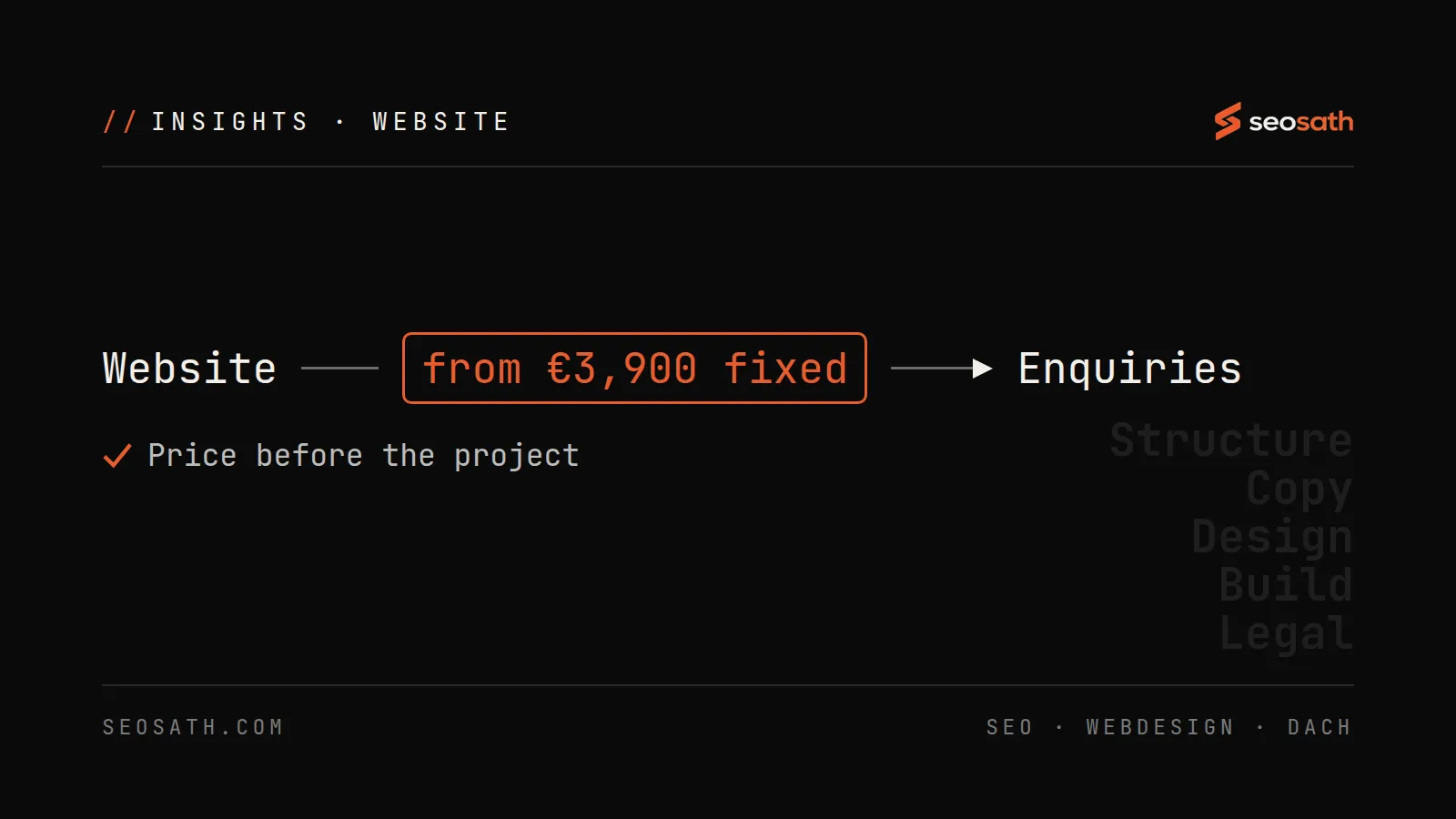
There is no one-size answer to what a website costs, but there is a logical one. You pay for work in five areas: structure, copy, design, build and legal compliance. The price depends on who does that work (you with a site builder, or a provider for a fee) and on what the website needs to achieve.
Having a website is common among German businesses but far from universal: according to the Federal Statistical Office (Destatis), 69 percent of enterprises in Germany had their own website in 2023, and among enterprises with 1 to 9 employees it was around 65 percent (Statista, data: Destatis 2023). Roughly one in three micro-businesses had none.
Short answer: what does a website cost a small business?
What a website costs depends on who does the work on structure, copy, design, build and legal compliance. With a site builder you mainly pay a monthly fee and invest your own time. With freelancers and agencies you pay for the work, and quotes differ mainly in which of those five areas are actually included.
At seosath, a one-page website costs €999 ($1,100) and a multi-page business website with copy, a design system and an SEO foundation starts at €3,900 ($4,400), both net at a fixed price. The full price list is further down.
Running costs for domain, hosting and maintenance come on top, plus SEO if the site is meant to win enquiries from search.
Four routes to a website and how the costs compare
The routes differ mainly in who does the work. What you save on fees, you pay for in your own time or in compromises on quality.
| Route | One-off | Running | Your effort | Fits when |
|---|---|---|---|---|
| Site builder (for example Wix, Jimdo, Squarespace) | low | the provider's monthly fee | high: copy, design, upkeep, legal | you have time and the site is mainly a business card |
| WordPress with a theme, yourself or with a freelancer | low to medium | hosting, licences, updates | medium | the scope is clear and someone owns the upkeep |
| Freelancer, custom build | medium | hosting, maintenance by the hour | medium: copy usually from you | you supply the content and want one point of contact |
| Agency or studio at a fixed price | higher | hosting, optional retainer | low: approvals instead of execution | the site has to bring enquiries and be found in search |
A special case is the website subscription: instead of a one-off price, you pay a monthly rate over a fixed term. That protects cash flow. Before signing, check who owns the design, copy and domain when the contract ends, and whether you can take the site to another provider.
What drives the price of a website
If two quotes are far apart, look at these seven points:
- Scope and page types. The price depends less on the raw page count than on the number of distinct page types. Ten service pages built on one pattern are less work than five completely different pages.
- Copy. It is a large cost item that is easy to overlook when comparing quotes. Good copy fully answers a search question and sounds like your company, which takes research, a conversation with you and revisions.
- Design. A bought theme, a custom design system and a fully bespoke layout are far apart in effort.
- Features. A contact form with spam protection, online booking, multiple languages, a shop or a CRM integration each add noticeably to the scope.
- SEO foundation. Keyword and intent research, a page structure based on search demand, titles, headings and structured data. Without it the site is online but not aligned with the terms your customers search for.
- Legal compliance. For sites aimed at Germany: a legal notice (Impressum) under § 5 of the German Digitale-Dienste-Gesetz (DDG), which you can pre-check with our free Impressum generator (German), a privacy policy, cookie consent only where § 25 TDDDG requires it, and, depending on what you offer, accessibility under the Accessibility Strengthening Act (BFSG), in force since 28 June 2025 (BFSG, official legal text). Whether your site is covered is explained in our article on BFSG website requirements.
- Relaunch instead of a new build. Replacing an existing site also needs a URL inventory, a redirect list and carrying over the content that ranks today. Why that is not a detail is covered in Traffic drop after a website relaunch.
Items that quotes often leave out
Two quotes at a similar price can contain very different work. Ask about these points before you compare totals:
- Copy: will it be written, edited, or does the provider expect it from you?
- Images: are photos, image rights or a shoot included?
- Redirects in a relaunch: is there a complete list of old URLs with their destinations?
- Legal texts and consent: who writes the legal notice and privacy policy, and does the site need a cookie banner at all?
- Accessibility: is it checked, and against which standard?
- Search Console and sitemap: is the site set up in Search Console, the sitemap submitted and the launch monitored?
- Handover: do you get all access, the code and the domain in your name?
- Revision rounds: how many are included, and what does each additional one cost?
A fuller list for talking to providers is in our web agency checklist.
Running costs after launch
After launch you pay for domain, hosting, maintenance and licences, plus content and SEO if the site is meant to bring enquiries from search. How much depends mainly on the technical system.
- Domain: an annual fee at the registrar.
- Hosting: depends on the system. A static site without a database needs less server capacity and less maintenance than a CMS with plugins.
- Maintenance: updates for CMS, theme and plugins, backups, security checks. With WordPress this is a regular task, with static sites far less often.
- Licences: paid themes, plugins, fonts and image libraries.
- Content and SEO: new pages, articles and optimisation if the site is meant to bring enquiries from search. Our SEO retainer starts at €990 ($1,100) net per month, with a three-month minimum term.
- Legal updates: legal texts change when laws change or new services are added.
A cheaply built website with high maintenance can end up costing more over the years than a cleanly built one with low running costs. Compare the total cost over the planned lifetime, not just the entry price.
What a website costs at seosath
At seosath the fixed price is set before the project starts. All prices are net; the full overview is on the pricing page.
| Service | Price | Scope |
|---|---|---|
| Strategy call | €190 ($220) | 60 to 75 minutes of live analysis, action list as PDF, credited if you commission a project |
| One-pager plus compliance setup | €999 ($1,100) | one page, individual design, legal texts, basic SEO, one to three weeks |
| Business website | from €3,900 ($4,400) | strategy, sitemap, design system, copy, build, SEO foundation, eight to twelve weeks |
| Premium website | from €5,900 ($6,600) | more pages and templates, CMS integration or a second language |
| Website relaunch with SEO migration | from €3,900 ($4,400) | rebuild plus SEO migration, redirects, monitoring through the first 30 days, eight to twelve weeks |
| Branding | €2,500 ($2,800) | positioning, tone, logo, colour system, typography; €2,000 ($2,250) as a bundle with a website project |
| SEO retainer | from €990 ($1,100) / month | technical work, content, internal links, reporting, three months minimum |
The website package can be paid in instalments; the standard split is 40 percent at sign-off of the first phase, 30 percent at sign-off of the copy and 30 percent at launch.
Fixed price or hourly rate?
For a website project with a clearly defined scope, a fixed price is usually the better choice because the provider carries the risk: if a phase takes longer, the client does not pay for it. An hourly rate makes sense when the scope is genuinely open, such as ongoing small changes.
A fixed price needs a clearly defined scope, which is why a serious fixed price is always preceded by a conversation about goals, pages and content.
With fixed prices, check what happens when things change. A good fixed price states the included revision rounds and the price of extensions before they arise. At seosath, two revision rounds per phase are included.
Self-check: which route fits you?
Which route fits depends on what the website needs to achieve and how much of the work you want to take on yourself. As a guide:
- You need a business card that is found under your name: a one-pager or a site builder, depending on whether you want to do the work yourself.
- The website should bring enquiries regularly: a multi-page site with a page per service and an SEO foundation.
- You already have a site that ranks today: relaunch only with a redirect list and content carried over.
- You do not know where you stand: diagnosis first, decision second. The strategy call establishes in 60 to 75 minutes which scope you actually need.
Frequently asked questions
What does a simple website for a freelancer or sole trader cost?
With a site builder you mainly pay the provider's monthly fee and your own time. At seosath, a professionally built one-pager with legal texts and basic SEO costs €999 ($1,100) net at a fixed price.
Why do website quotes vary so much?
Because they contain different work. The biggest differences are in copy, design, the SEO foundation, legal compliance and the handover. Compare quotes line by line, not by the total.
What does a website relaunch cost?
A relaunch costs as much as a new build plus the migration: URL inventory, redirects and carrying over the content that ranks today. At seosath a relaunch with SEO migration starts at €3,900 ($4,400) net.
What are the running costs of a website?
Domain, hosting, maintenance and updates, licences where needed, and content and SEO if the site is meant to bring enquiries. A static site generally needs less maintenance than a CMS with many plugins.
Does every website in Germany need a cookie banner?
No. Under § 25 TDDDG, consent is required when information is stored on or read from the user's device that is not strictly necessary for the service, for example for analytics or marketing tools. A site that uses no such tools and embeds no third-party content that sets its own cookies does not need a cookie banner.
Sources:
- Statista: share of enterprises with a website by size class in Germany, 2023, data source Federal Statistical Office (Destatis), survey on ICT usage in enterprises
- BFSG, official legal text: in force since 28 June 2025
- Federal Agency for Accessibility (Bundesfachstelle Barrierefreiheit), BFSG FAQ: in force since 28 June 2025, covered services and exemptions
- Digitale-Dienste-Gesetz (DDG), § 5: general information duties (legal notice)
- Telecommunications Digital Services Data Protection Act (TDDDG), § 25: consent for storing and reading information on end devices
- seosath prices: pricing page, as of September 2026